
👷♂️ Flat Roof Waterproofing in Singapore : Case Study
Introduction
In Singapore’s tropical climate, "waterproofing" isn’t just a luxury—it’s a necessity. With intense UV rays during the day and torrential Northeast Monsoon rains at night, building materials undergo extreme thermal expansion and contraction.
Recently, High Tech Roofing & Waterproofing was called to a residential project in a landed estate where the homeowner had already engaged two different contractors, yet the leaks persisted. This case study explores how a "deep-dive" inspection and specialized membrane application finally solved the problem.
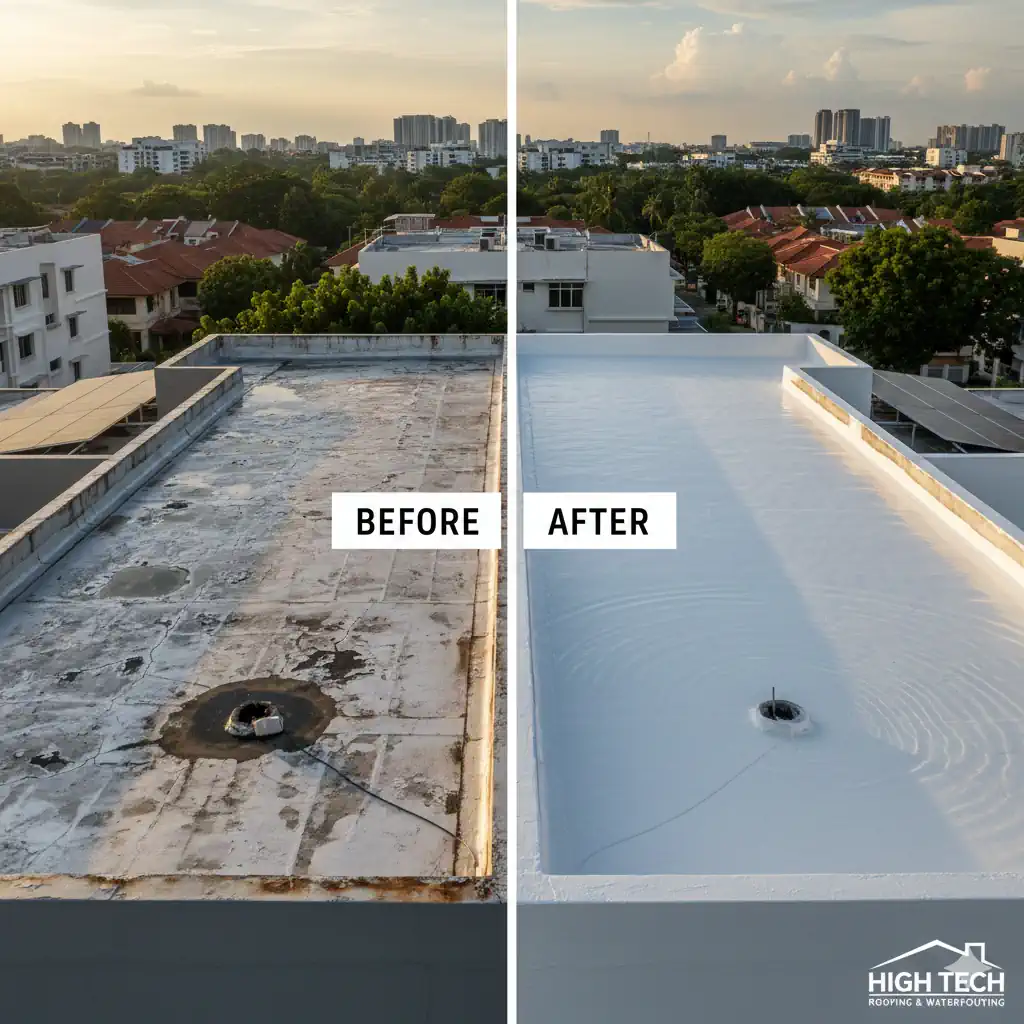
The Challenge: The "Ghost" Leak
The client, a homeowner of a three-story semi-detached house, was frustrated. Every time a heavy downpour hit, a large water stain appeared on the master bedroom ceiling.
Previous Attempts:
- Contractor A applied a "quick-fix" sealant over the visible cracks.
- Contractor B suggested painting over the ceiling with waterproof paint.
Both failed because they addressed the symptom, not the source. In Singapore’s high-density housing, water often travels along concrete beams, meaning the actual entry point can be meters away from where the drip appears.
The High Tech Solution: A 3-Step Specialist Approach
Step 1: Thermal Imaging & Moisture Detection Instead of guessing, our team used thermal imaging cameras to trace the moisture path. We discovered that the leak wasn't coming from the ceiling's center. Instead, water was entering through a hairline crack near a solar panel mounting bracket on the roof edge.
Step 2: Substrate Preparation (The Secret to Longevity) Many contractors skip this, but we don't. We used high-pressure water jetting (2,000 PSI) to remove old, peeling "silver paint" and carbonation layers. This revealed that the concrete underneath was saturated. We waited for a 48-hour dry window to ensure the new membrane would "bond" perfectly.
Step 3: Multi-Layer Polyurethane (PU) Membrane We chose a Liquid-Applied Polyurethane Membrane for this project.
- Why? Unlike traditional torch-on membranes, PU is seamless. It flows into every corner and creates a flexible, "rubber-like" skin that moves with the building.
- Reinforcement: We added a fiberglass fleece layer to the joints to ensure that future structural movement wouldn't tear the waterproofing.
The Results: 100% Watertight
Following the application, we conducted a 24-hour Ponding Test (standard BCA procedure). We plugged the drains and flooded the roof with 2 inches of water.
- Outcome: Zero seepage.
- Bonus: The reflective white topcoat reduced the surface temperature of the roof by 5°C, lowering the client’s air-conditioning costs.
Key Takeaways for Singapore Homeowners
- Don’t DIY Roof Leaks: Surface sealants from hardware stores are temporary fixes that trap moisture inside the concrete, leading to spalling concrete.
- Check Your Flashings: 80% of leaks in terrace houses occur at the metal transition (flashing) between your roof and your neighbor's wall.
- Insist on a Warranty: A professional waterproofing job in Singapore should come with at least a 5-year warranty.
Conclusion
Don’t let a small leak turn into a structural nightmare. At High Tech Roofing & Waterproofing, we are BCA-registered specialists dedicated to protecting Singaporean homes from the elements.
Need Roof leak fixing company local singapore area? Contact the specialists at High Tech Roofing & Waterproofing today. 📞 Call/WhatsApp: +65 8292 6757 📧 Email: [email protected] 🌐 Visit: hightechroofing.com.sg