
The Technical Guide to Roof Coating Systems in Singapore
Engineering-Grade Elastomeric Solutions, Thermal Mitigation, and Asset Life Cycle Management
In an equatorial climate like Singapore's, a property's roof serves as its most critical shield against severe weather. Unlike building systems in temperate zones, an exposed roof envelope in this region is constantly exposed to heavy UV radiation, high relative humidity, and sudden thermal changes. During a standard afternoon heat cycle, the surface temperatures of reinforced concrete flat roofs, metal roof claddings, and fiber-cement structures routinely climb above 60°C. When a sudden tropical monsoon shower hits, this surface temperature can plunge down to 28°C in under fifteen minutes.
This rapid cooling creates intense thermal shock within structural building materials. The resulting stress causes hairline cracks in masonry, loosens joint sealants, opens seams in metal decks, and leads to early failure of low-grade paints. When the roof envelope cracks, atmospheric moisture enters through capillary action, leading to internal ceiling leaks, spalling concrete, and structural decay.
For asset managers and property owners across Singapore, applying a high-performance, engineering-grade protective roof coating is a reliable, cost-effective way to restore waterproof protection without the high cost of a complete roof replacement. At HIGH TECH ROOFING & WATERPROOFING Singapore, we avoid temporary surface patches. As a Building and Construction Authority registered and business safety certified contractor, our engineering teams deploy advanced, multi-layer liquid elastomeric and thermal-reflective coating systems designed to protect your building long-term.
1. Material Forensics: Comparing Liquid Polyurethane (PU) and Acrylic Roof Coatings
Liquid roof coatings are not standard architectural paints; they are cold-applied fluid membranes engineered to cure into a tough, rubbery, waterproof shield across the entire substrate. Choosing the right material chemical profile depends on the roof's pitch, structural movement, and standing water conditions.
[Premium UV-Resistant Top Coat]
       └──> [Reinforcing Fiberglass Structural Mesh Core]
                  └──> [High-Elastic Elastomeric Base Coat]
                             └──> [Substrate-Specific Deep Bond Primer]
                                        └──> [Mechanically Ground Roof Deck]
A. Liquid-Applied Polyurethane (PU) Coating Membranes
Liquid polyurethane represents the gold standard for flat reinforced concrete roofs and commercial podium decks prone to occasional water ponding.
- High Elastic Elongation: Advanced polyurethane coatings provide outstanding flexibility, often stretching beyond 300% of their dry state. This elasticity allows the cured membrane to span and bridge moving hairline fractures as the building expands and contracts daily.
- Chemical Resistance and Tensile Strength: Polyurethane features cross-linked polymer bonds that resist standing water, airborne pollutants, and bird droppings. It remains tough and stable under foot traffic and building maintenance access.
- Substrate Moisture Considerations: Polyurethane is highly sensitive to moisture during application. If applied over a damp substrate without a specialized epoxy moisture barrier primer, trapped moisture will expand into water vapor under midday heat. This creates pressure pockets that lead to blisters and early peeling.
B. High-Build Elastomeric Acrylic Coatings
For pitched roofs, terracotta roof tiles, metal deck flashings, and vertical parapet walls, high-build elastomeric acrylic coatings provide an efficient, breathable defense.
- Solar Vapor Breathability: Acrylic coatings feature a semi-permeable structure that allows trapped moisture vapor to escape from the building sub-base while completely blocking liquid rainwater. This breathability prevents hydrostatic pressure buildup and blistering.
- UV Stability: Acrylic polymers naturally resist ultraviolet degradation. They do not turn brittle, yellow, or crack under continuous exposure to intense sunlight, maintaining their elastic performance over long service lifespans.
- Water Ponding Limitations: Acrylic chemistry breaks down under long-term contact with standing water. If used on flat concrete roofs with poor drainage, the film can soften and re-emulsify, making it unsuited for low-slope roofs with frequent water pooling.
2. The Science of Thermal Reflection: "Cool Roof" Technology
Applying a roof coating offers significant benefits beyond standard waterproofing. By utilizing advanced thermal-reflective coatings, property owners can transform a dark, heat-absorbing roof into an energy-efficient "cool roof."
[Solar Radiation / Intense UV] ────> ☀️
                                    │  \ 85% Reflected (High Albedo)
                                    ▼   \
                       [Reflective Top Coat Layer]
                       ===========================
                       [Concrete Roof Sub-Base] ──> (Interior Temp Dropped by 3°C to 5°C)
High-Albedo Solar Reflectance Index (SRI)
Standard dark roof membranes absorb up to 90% of solar radiation, transferring that intense heat directly down into the building's interior spaces. In contrast, premium cool roof coatings are formulated with specialized ceramic or titanium dioxide micro-spheres that deliver a Solar Reflectance Index score exceeding 100.
- Lowering Indoor Temperatures: Reflective topcoats bounce up to 85% of solar heat away from the building, dropping internal attic and living space temperatures by 3°C to 5°C. This directly reduces energy use by lowering air-conditioning loads.
- Reducing Thermal Shock: Reflective coatings keep the underlying roof structure cooler throughout the day, limiting the extreme expansion and contraction cycles that stress building joints. This preservation extends the overall life of the roof structure.
3. The Professional 5-Step Application Process
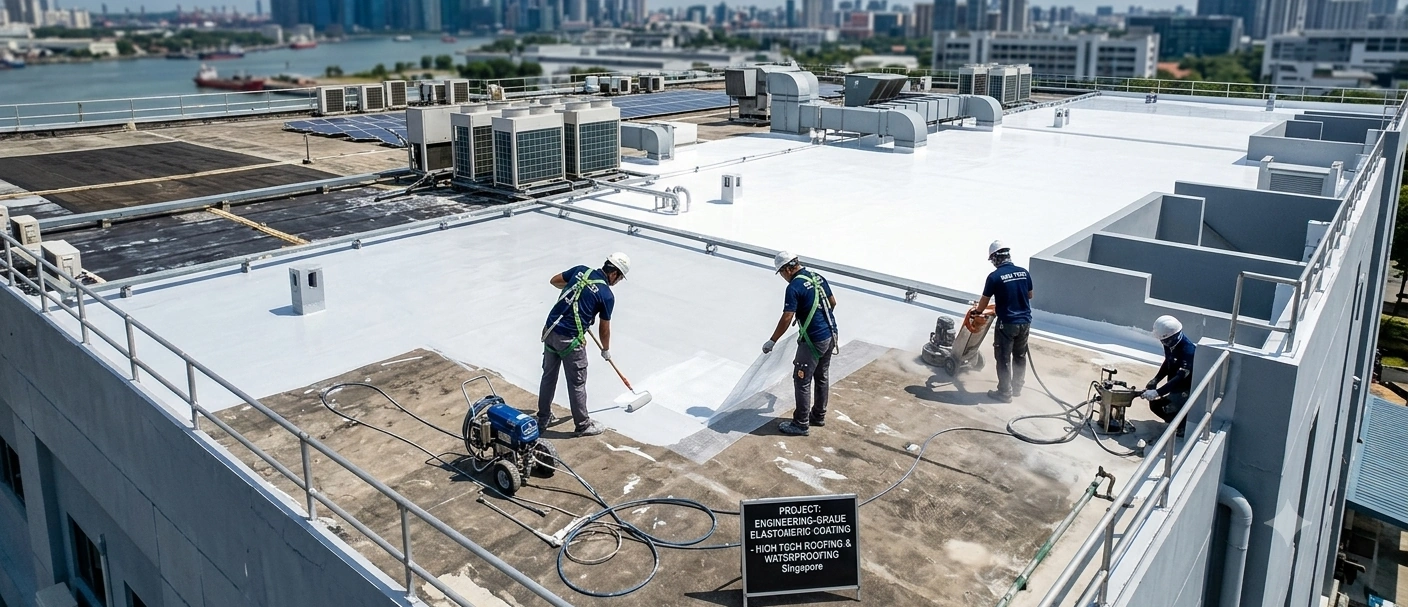
A roof coating system is only as reliable as its surface preparation and application precision. HIGH TECH ROOFING & WATERPROOFING Singapore follows a strict, five-step application framework to guarantee maximum adhesion and durability.
Step 1: Mechanical Substrate Profiling
A coating requires a clean, solid surface to achieve a strong mechanical bond. We begin by removing old, failing coatings, oil stains, and organic moss growth using high-pressure water jetting equipment operating at over 2,000 PSI. For concrete roofs, we use mechanical grinding disks to open up the concrete pores and remove weak laitance layers.
Step 2: Structural Fracture Remediation
Every visible structural crack and split seam must be treated before applying the primary system coating. We vee-cut cracks, clean out debris, and seal them with high-modulus polyurethane sealants. For active, deep water leaks through the concrete slab, our technicians use high-pressure polyurethane injection grouting at forces up to 200 bar to seal the water path from the inside out.
Step 3: Deep Bond Primer Infrastructure
We apply a substrate-specific primer across the entire clean roof surface. For concrete, a deep-penetrating epoxy primer seals micro-pores and blocks alkaline salts from rising. For metal roofs, a specialized rust-inhibiting primer neutralizes surface corrosion and stops oxidation from undermining the new coating.
Step 4: Multi-Layer Coating Application with Matrix Mesh Reinforcement
We never apply a roof coating in a single thick layer, as that leads to skinning and internal trapping of un-cured liquid. Instead, we apply a minimum of two separate, uniform coats using a cross-hatch pattern. At high-stress zones—such as floor-to-wall junctions, rainwater downspouts, and right-angle pipe penetrations—we embed an alkali-resistant fiberglass mesh cloth directly between the coats to create a tough, reinforced joint shield.
Step 5: Controlled Curing & Verification Testing
The complete system is left to cure under controlled conditions, protecting it from sudden rain or foot traffic. For flat concrete surfaces, we perform a comprehensive 24-hour water ponding test to confirm a completely leak-free seal before officially handing over the project.
4. Why Avoid Generic DIY Liquid Paints?
While retail hardware stores offer inexpensive waterproofing paints, using generic DIY materials on exposed roofs in Singapore often leads to system failure within 12 to 24 months.
- Insufficient Film Thickness: Retail products lack the high solids content needed to form a durable barrier, resulting in a thin layer that quickly wears away under heavy monsoon rain and UV exposure.
- Poor Elastic Memory: Cheap coatings lack advanced polymer components. Once stretched by building movement, they fail to snap back into shape, causing the thin skin to tear open along structural joints.
- Lack of Specialized Equipment: Professional installations require calibrated wet-film gauges, mechanical surface grinders, and moisture-impedance meters to ensure correct application parameters. Skipping these technical steps often results in pinhole leaks and early peeling.
🛠️ The HIGH TECH Engineering Advantage
When you choose HIGH TECH ROOFING & WATERPROOFING Singapore, you receive a comprehensive service built on safety, quality, and technical expertise:
- BCA Registered Competence: Our registration with the Building and Construction Authority confirms that our teams adhere strictly to Singapore's building control regulations and high quality standards.
- bizSAFE Certified On-Site Management: Roof work involves working at heights. Our bizSAFE certification ensures that every project uses strict safety setups, including certified edge guards and fall-arrest systems, to protect both workers and your property.
- Advanced Thermal Imaging Inspections: We do not guess where a leak originates. Our technicians map hidden water paths underneath old surfaces using infrared thermography, ensuring repairs target the true root cause.
- Transparent, Written Warranties: Every project is backed by an enforceable, written warranty covering both premium materials and workmanship, giving you long-term security.
📩 Protect Your Roof Structure Today
Do not wait for the next heavy monsoon season to address a failing roof membrane. Protect your building asset, lower your energy bills, and avoid expensive structural remediation work.
Contact HIGH TECH ROOFING & WATERPROOFING Singapore today to set up your Free On-Site Technical Inspection and Detailed Project Cost Assessment. Our certified field engineers will evaluate your property's specific layout and provide a targeted, high-performance solution designed to keep your building dry for years to come.